The development of the Oude Kerk into a lively public space
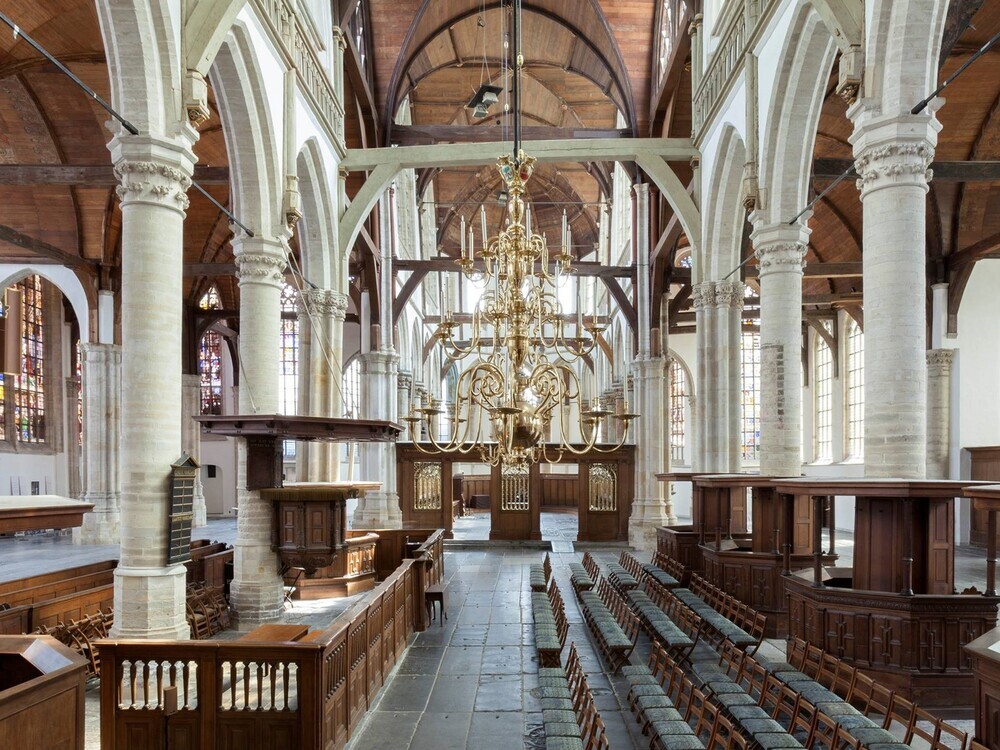
At the same time as this expansion, the high choir and the Koaromgang (abulatory) were also added to the nave. With this, around the middle of the fifteenth century, the main structure of the Oude Kerk was completed. At the end of the fifteenth and beginning of the sixteenth century, further expansions of the Noorderzijbeuk and Zuiderzijbeuk, such as the side chapels and
transept
, followed, and the nave was raised, giving the church its present form.
While the
Hoogkoor
(high choir) formed the liturgical center of the church, the daily life of the people of Amsterdam largely took place in the nave and side aisles. These spaces were places where people gathered or listened to so-called walking concerts between masses. The many paintings, prints and drawings made of the Oude Kerk - by Emanuel de Witte and others - not only show the architecture of the building, but also capture the social character of the church.
In Catholic times, the Oude Kerk housed numerous statues of saints and
altars
dedicated to specific saints. These did not survive the Beeldenstorm - a period of iconoclast outbreaks throughout Northern Europe - and the subsequent
Alteration
. For Protestants, richly decorated altars and images of saints were considered idolatry; they strove for a sober church interior that would not distract attention from worship. Using historical sources, it has largely been possible to reconstruct which images and altars were located in different places in the church. Near almost every pillar between the side aisles and the nave was an altar set up, maintained by different
guild
s. For example, there were altars dedicated to Mary Magdalene and to
Saint Nicholas
.
In addition, after the Alteration, the polychrome
vault paintings
of the Oude Kerk were painted over, again this was done to create a more sober church interior. During the restoration that began in 1955, the vault paintings were largely restored. The paintings in the south aisle were largely restored, they are depictions of Saint John Evangelist, Saint Crispinus and Crispinianus, Saint Martin, the
Coat of arms of Holland
with the coat of arms of Amsterdam, a Pieta in a nave, a bullet ship and (possibly) Saint Christopher. In the north aisle, only one vault painting is visible; depicted is a horseman with a candle and sword.
Minimise the description