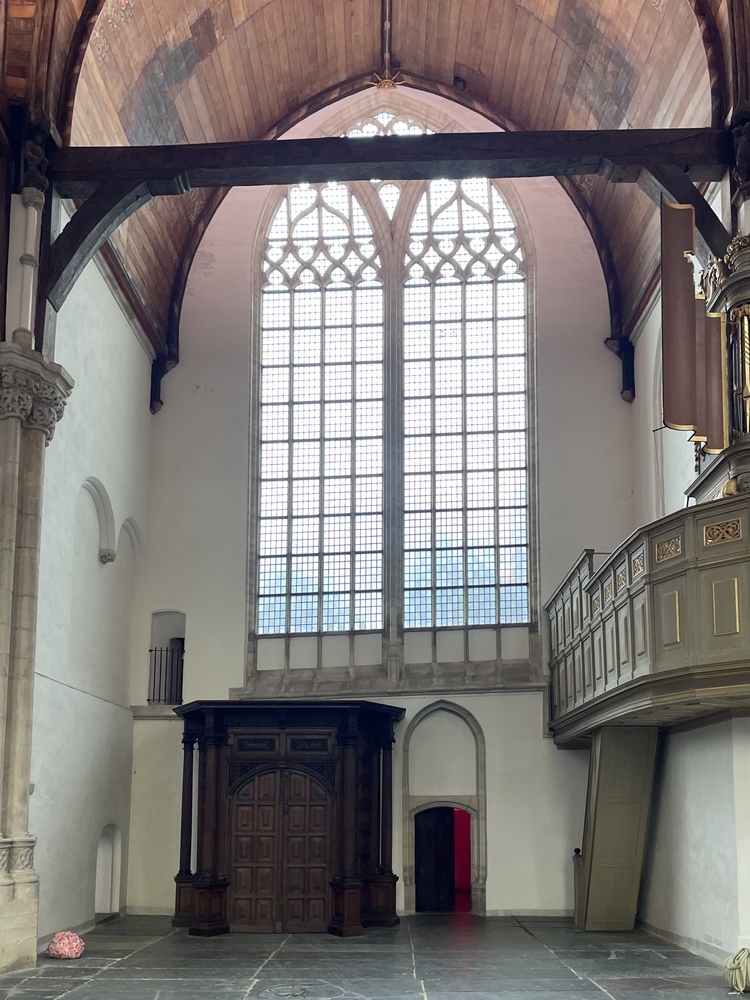
The Weitkoperskapel founded by a brewer
The chapel's name refers to Jan Claesz Van Hoppen, the chapel's founder, who was presumably known as a "weitkoper. Weit is a synonym for grain in Old Dutch. As a brewer, Van Hoppen will have purchased large quantities of grain to produce ele - a sweet beer variety with fewer hops - in his brewery.
Jan Claesz's surname also refers to his profession: born Jan Claesz. Smittenz, he chose to call himself “van Hoppen,” a clear allusion to brewing beer, in which hops are an important ingredient. The van Hoppen family crest can be seen in the stained-glass window depicting the Annunciation and Visitation, which was donated by his son, Jan Claesz van Hoppen (II), who bore the same name.
Graves in the Weitkoperskapel
Jan Claesz van Hoppen and his wife Styn Tymensdr are buried in the Weitkoperskapel, but otherwise there was little enthusiasm among wealthy citizens to be buried in this chapel; due to its location next to the
Noorderportaal
and the Holy Sepulchre, there was a lot of walk-through so inscriptions on the tombstones quickly faded.
The Oude Kerk's most famous grave, however, does lie in this chapel.
Saskia Uylenburgh
was buried here in 1642 at the age of 29. Her husband Rembrandt van Rijn bought a grave for Saskia in the Oude Kerk, but sold it again 20 years later to pay for the burial of his second wife, Hendrickje Stoffels.
The effects of the Iconoclasm
In Catholic times, the Oude Kerk contained numerous statues of saints and
altars
dedicated to specific saints. These did not survive the
Beeldenstorm
and the subsequent
Alteration
. For Protestants, richly decorated altars and images of saints were considered idolatry; they strove for a sober church interior that would not distract attention from worship. Using historical sources, it has largely been possible to reconstruct which images and altars were located in different places in the church. In the Weitkoperskapel there was an altar dedicated to St. Jacob.
Minimise the description