Geometry of the Scattering: Kannadi from Square to Circle
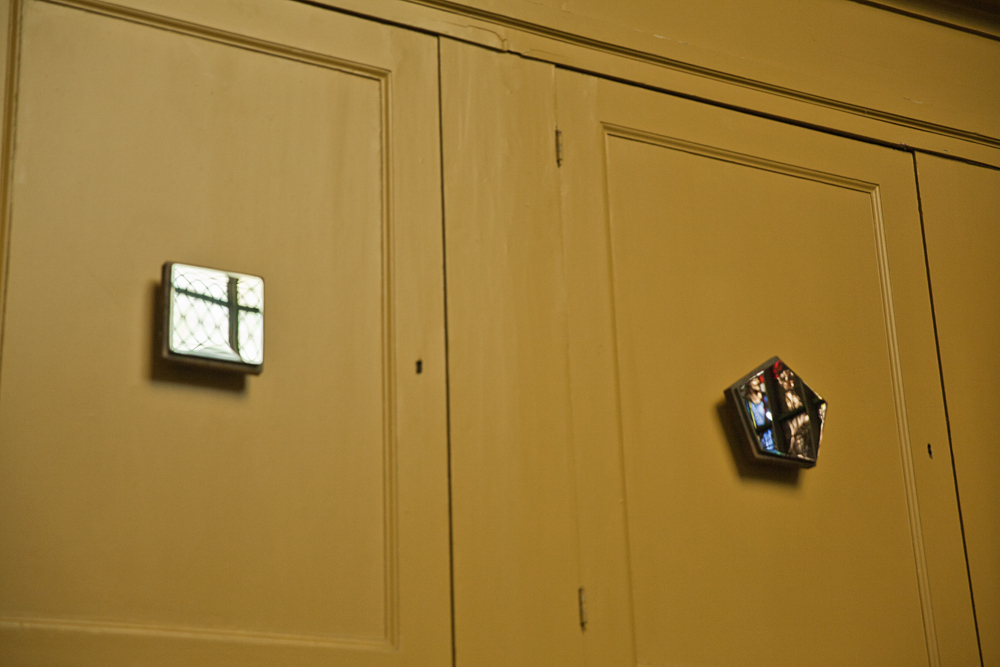
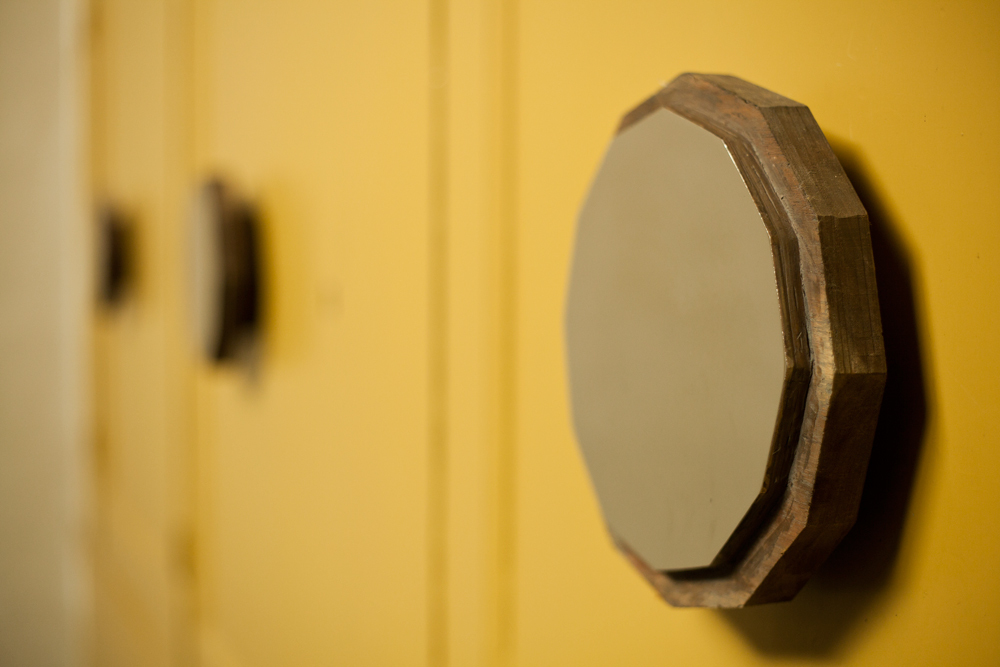
The work Kannadi from Square to Circle comes out of research Kruip conducted in the Indian state of Kerala. Situated on the banks of the Pamba river, the small village of Aranmula is best known for the temple of Lord Parthasarathy, which has been associated with Indian culture for centuries. Traditional handwork in Aranmula is closely tied to ritual. The Aranmula Kannadi is a unique object. Mysterious in its creation and unequalled in its beauty this mirror is made from metal rather than glass. Perfecting the reflective quality of the mirror is achieved through an intensive process of polishing. In a canon developed by the tribal chief of Aranmula, the mirror has been described as one of the eight essential objects to be used in Hindu religion. Later the mirror became popular among aristocratic women and in order to be able to hold the mirror up they were cast in bronze.
In 2011, Kruip visited Aranmula to study the production process of the Kannadi. She quickly discovered that over the past centuries the mirror has always been circular: the circle being a symbol for the state of a higher consciousness throughout the entire spiritual and ritual history. Fascinated by this detail the artist asked the artisans to make a mirror that was square instead of round. In making this simple request the logic, work ethic and spiritual relationship with the object changed drastically.
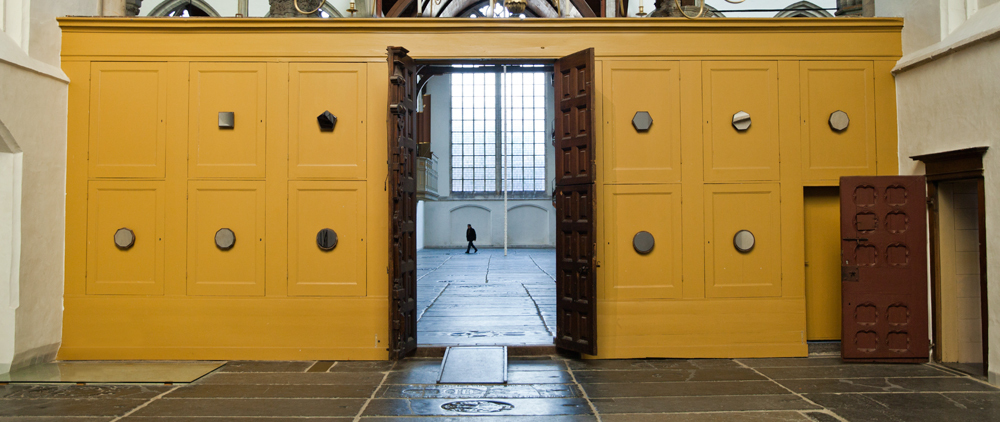
As with earlier work, Kannadi from Square to Circle Kruip studies the relationship between geometric forms and spirituality, in this case the tension between the square and the circle. In Dervish tradition the transition from square to circle reflects various stages of consciousness. The soul, matter, nature, the body, the universe, are some of the phases that shape the Dervish ritual. For Kannadi from Square to Circle Kruip incorporates Dervish tradition into the Aranmula Kannadi by producing 10 mirrors reflecting each of mentioned stages. The mirrors are placed on the 10 panels of the doors to the Saint Sebastian’s chapel. By simply concentrating only on geometric forms Kruip establishes a connection between different religions.
| Artist | Kruip, Germaine |
| Period |
21st century
(2015) |
| Location | Sint-Sebastiaanskapel |
Geometry of the Scattering: Kannadi from Square to Circle
The work Kannadi from Square to Circle comes out of research Kruip conducted in the Indian state of Kerala. Situated on the banks of the Pamba river, the small village of Aranmula is best known for the temple of Lord Parthasarathy, which has been associated with Indian culture for centuries. Traditional handwork in Aranmula is closely tied to ritual. The Aranmula Kannadi is a unique object. Mysterious in its creation and unequalled in its beauty this mirror is made from metal rather than glass. Perfecting the reflective quality of the mirror is achieved through an intensive process of polishing. In a canon developed by the tribal chief of Aranmula, the mirror has been described as one of the eight essential objects to be used in Hindu religion. Later the mirror became popular among aristocratic women and in order to be able to hold the mirror up they were cast in bronze.
In 2011, Kruip visited Aranmula to study the production process of the Kannadi. She quickly discovered that over the past centuries the mirror has always been circular: the circle being a symbol for the state of a higher consciousness throughout the entire spiritual and ritual history. Fascinated by this detail the artist asked the artisans to make a mirror that was square instead of round. In making this simple request the logic, work ethic and spiritual relationship with the object changed drastically.
As with earlier work, Kannadi from Square to Circle Kruip studies the relationship between geometric forms and spirituality, in this case the tension between the square and the circle. In Dervish tradition the transition from square to circle reflects various stages of consciousness. The soul, matter, nature, the body, the universe, are some of the phases that shape the Dervish ritual. For Kannadi from Square to Circle Kruip incorporates Dervish tradition into the Aranmula Kannadi by producing 10 mirrors reflecting each of mentioned stages. The mirrors are placed on the 10 panels of the doors to the Saint Sebastian’s chapel. By simply concentrating only on geometric forms Kruip establishes a connection between different religions.
Gallery
Connections
Part of
Read more
Identifiers and references
| Oude kerk Adlib Collect priref | 2526 |