Anastasis
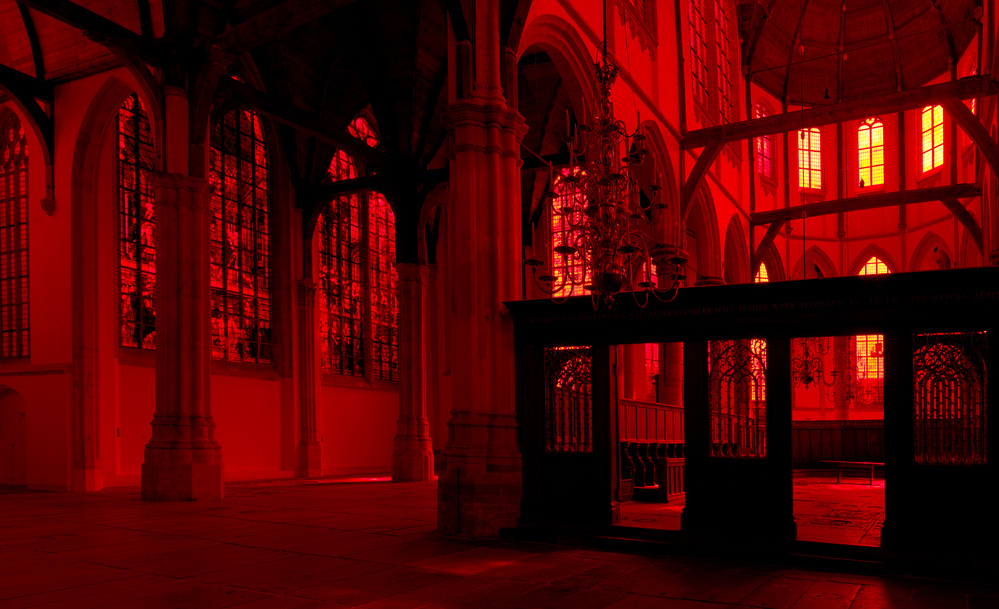
Giorgio Andreotta Calò drastically altered the the church’s interior. During the summer months of 2018, visitors were bathed in an ocean of red light, an inimitable experience. In the evening, the red light emitted from the church, coalescing with the red lights of the plentiful brothels and prostitution windows surrounding the building. Throughout the summer, the church was split between these moments of light and shade: its interior and exterior circulated around each other, to the rhythm of sunlight and its imminent inversion.
With his red light, Calò brought the Roman Catholic visual idiom back into the building and reflected on the Iconoclastic Fury of 1566 and the revolution in religious thinking. During the exhibition, the artist used images of the only surviving Catholic stained-glass window, a depiction of the Death of the Virgin Mary, as the point of departure for a new photographic work, to which the Rijksakademie (the Dutch State Academy of Fine Arts) was also contributing. The red light did not effect the undeveloped image and provided the same conditions as in a photographic darkroom. The church served as studio and darkroom. Afterwards, the photographic work travelled to Milano (Triennale Museum) and Rome (MAXXI Museum).
| Artist | Calò, Giorgio Andreotta |
| Curator | Grandjean, Jacqueline |
| Period |
21st century
(25-05-2018 – 23-09-2018) |
| Location | Oude Kerk |
Anastasis
Giorgio Andreotta Calò drastically altered the the church’s interior. During the summer months of 2018, visitors were bathed in an ocean of red light, an inimitable experience. In the evening, the red light emitted from the church, coalescing with the red lights of the plentiful brothels and prostitution windows surrounding the building. Throughout the summer, the church was split between these moments of light and shade: its interior and exterior circulated around each other, to the rhythm of sunlight and its imminent inversion.
With his red light, Calò brought the Roman Catholic visual idiom back into the building and reflected on the Iconoclastic Fury of 1566 and the revolution in religious thinking. During the exhibition, the artist used images of the only surviving Catholic stained-glass window, a depiction of the Death of the Virgin Mary, as the point of departure for a new photographic work, to which the Rijksakademie (the Dutch State Academy of Fine Arts) was also contributing. The red light did not effect the undeveloped image and provided the same conditions as in a photographic darkroom. The church served as studio and darkroom. Afterwards, the photographic work travelled to Milano (Triennale Museum) and Rome (MAXXI Museum).
Connections
Explore the elements of the work
Read more
Het Rode raam in het Heilig Graf blijft tot op heden een tastbaar en betwist spoor van Giorgio Andreotta Calò's Anastasis.
Read more
{"nl":"","en":""}
Identifiers and references
| Oude kerk Adlib Collect priref | 2080 |