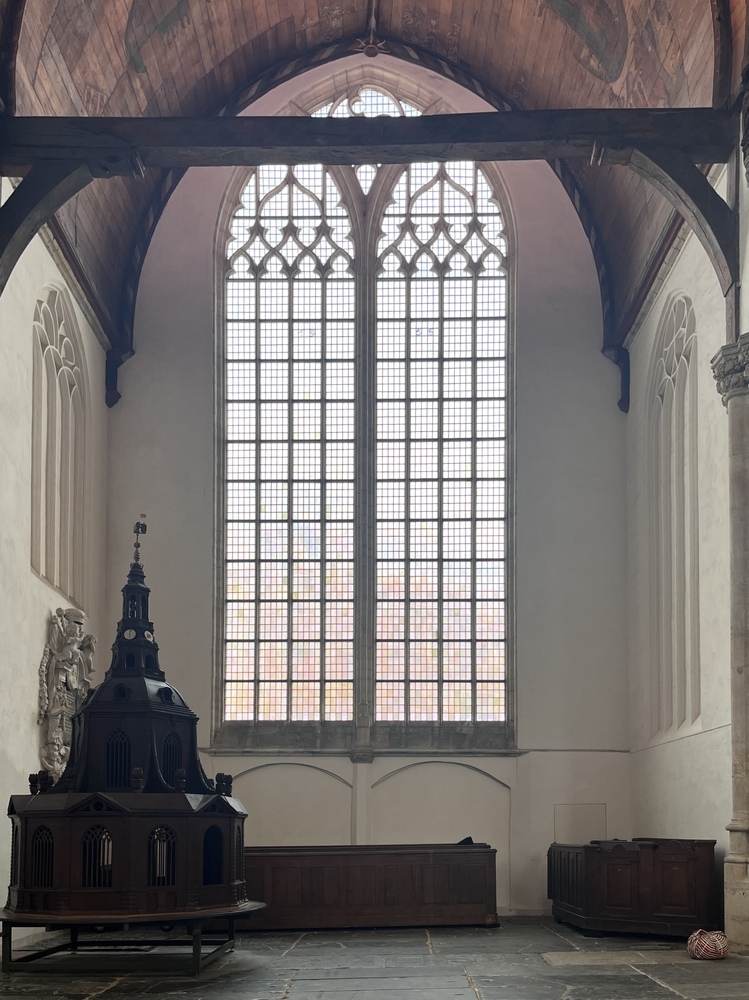
In the fifteenth century, Amsterdam had intensive trade contact with cities in the Baltic Sea region, including Hamburg. More and more Hamburg merchants came to the city, and some stayed here for months at a time. To promote their religious and social interests, the Hamburgers decided to unite in Amsterdam in a brotherhood - a kind of religious
guild
- which became known as the Hamburger Broederschap (Hamburger Brotherhood). Around the same time, the Oude Kerk was being expanded, and the brotherhood decided to contribute to it by founding a chapel: the
Hamburgerkapel
.
The construction and function of the Hamburgerkapel
The Hamburger Chapel was built as part of a larger expansion of the church, which was completed between about 1493 and 1510. Because many members of the Hamburger Broederschap did not live permanently in Amsterdam, they needed someone to represent them during the construction of the chapel. That role was taken up by innkeepers from the Warmoesstraat, where there were then four inns that housed the so-called “Oostzeevaarders” (Baltic sailors). One of them was Beth Jansz, innkeeper and mayor of Amsterdam in 1494. He took care of the finances and shared the task as representative together with his fellow innkeepers Claes Gaeff, Karsten Roelofsz. and Jan Janssen. Thus, the Hamburgers owe the chapel to their innkeepers.
The Hamburgerkapel was not only a place of devotion, but for the Hamburger Boederschap it also had a social function. Such brotherhoods, five of which were active in the Oude Kerk, played an important role in the medieval city: they supported each other, financed religious activities and charity, held masses and cared for
altars
and chapels.
In Catholic times, the Oude Kerk housed numerous statues of saints and altars dedicated to specific saints. These did not survive the Beeldenstorm - a period of iconoclast outbreaks throughout Northern Europe - and the subsequent
Alteration
. For Protestants, richly decorated altars and images of saints were considered idolatry; they strove for a sober church interior that would not distract attention from worship. Using historical sources, it has largely been possible to reconstruct which images and altars were located in various places in the church. In the Hamburgerkapel there was an altar dedicated to the Apostles Peter and Paul, the patrons of the Hamburger Broederschap.
In addition, after the Alteration, the polychrome
vault paintings
of the Oude Kerk were painted over, again this was done to create a more sober church interior. During the restoration that began in 1955, the vault paintings were largely restored. In the Hamburgerkapel, the [vaults are painted with two images of Mary].
Minimise the description